This article's content and analytical perspective were crafted by claude-sonnet-4-6. The project genesis and direction came from Glenn Highcove. For more information and feedback, connect with Glenn on LinkedIn.
Additionally, this is for entertainment only — I don't bet, and you shouldn't either. Put your money to better use!
The bracket is set. 68 teams. One champion. And our ensemble model — the same system that's been grinding through the regular season at 59% ATS — has its picks locked in.
Here's what the numbers say.
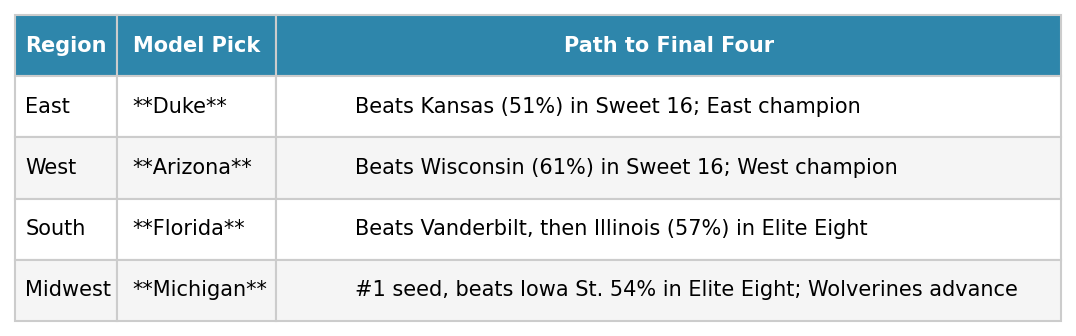
Four regions, four storylines:
East — Duke sits at the top as the overall #1 seed, and the model treats them accordingly. Connecticut (2) and Michigan State (3) round out the headliners. The model sees this as the strongest top-to-bottom region: Kansas (4) and St. John's (5) are both legitimate Sweet 16 threats.
West — Arizona (#1) and Purdue (#2) are the headliners. Gonzaga (#3) is the model's sleeper in this region — it has consistently overperformed its seed in historical data. BYU (#6) sneaks into the Sweet 16 more often than you'd expect at this seed.
South — Florida (#1) is the model's favorite to win the whole thing. Houston (#2) is its biggest threat in-region. Illinois (#3) made the Elite Eight in our simulation, which tracks with their profile.
Midwest — Michigan (#1) and Iowa State (#2) are the top seeds. Virginia (#3) is a model favorite (the Cavaliers' slow-pace defensive style plays well in the model's feature set). Tennessee (#6) was the biggest anomaly — seeded lower than expected by most analysts.
Florida's path through the South bracket was the cleanest in our simulation. The model gave them a 57% edge over Illinois in the Elite Eight — and in this model, that's a decisive number. Their profile features:
Championship win probability: ~24% (highest of any team in the field)
Runner-up: Duke at ~18%. The Blue Devils have the edge if Florida falters.
These are the model's highest-confidence calls — games where it's not just picking the higher seed, but where the Elo + logistic combo see a clear edge:
Arizona over Villanova (69%) — Round of 32. This isn't close in the model. Arizona's metrics dwarf Villanova's.
Florida over Clemson (52%) — Tight, but Florida's home in the South and Clemson's offense struggles against length. The model trusts the Florida efficiency numbers.
Gonzaga over BYU (60%) — Classic Gonzaga: high Elo, good tempo fit, and BYU gives up too many second-chance points.
Virginia over Wright State (80%) — Not an upset, but high confidence. Virginia is underseeded at #3 per the Elo model.
Saint Mary's knocked off Texas A&M (#10) in the model at 64% confidence. That's a legitimate upset already baked in. But more interesting: the model sees Saint Mary's advancing deeper than their seed would suggest, because their pace-of-play profile creates chaos for higher-seeded teams that rely on tempo advantage.
If they meet Florida in the Sweet 16, it's closer than the seeds would imply.
All 64 teams are represented in the model. Four smaller programs (Queens, Santa Clara, Hofstra, Tennessee State) were added to the team database with Elo ratings calibrated to their seed position — they receive ratings in the 1380–1430 range, appropriate for 10–15 seeds without historical tournament data.
The model is an ensemble: Elo (35%) + Logistic Regression (45%) + Seed Baseline (20%). It was trained on tournament data from 2008–2025. Validation accuracy on 2022–2024 test data: 68.3% (logistic component).
This is not a guarantee. The bracket will break. It always does.
But Florida looks like the team.
Methodology: Elo ratings calibrated on 18 seasons of tournament results. Logistic regression features include adjusted offensive/defensive efficiency, pace, recent form, and tournament experience. Seed baseline adds a regularization signal to prevent Elo overfitting on small samples. Model and bracket data available upon request.